
Crown Hair Loss: 3 Self-Check Methods You Can Do at Home
There are days when you’re drying your hair and, out of nowhere, something feels different in the mirror. Under bright elevator lighting or in a…
There are days when you’re drying your hair and, out of nowhere, something feels different in the mirror. Under bright elevator lighting or in a photo someone casually took, a thought suddenly appears: “Could this be hair loss?”

Most people brush it off. Six months pass. A year passes. During that time, crown hair loss continues quietly and steadily.
The difference between early intervention and delayed treatment is often significant in terms of final outcomes. Here are three simple self-check methods you can do at home to evaluate crown hair loss—and what you should do next.
Why Do People Notice Crown Hair Loss So Late?
M-shaped hair loss is easier to notice because the hairline changes visibly in the mirror. Crown hair loss, however, is different. You cannot directly see the top of your head, so density can decrease gradually without obvious awareness. Many people only notice it through photos or when someone else points it out. That is why crown hair loss is often detected late.

Crown Hair Loss Self-Check 1. Take Crown Photos Under Consistent Lighting
This is the simplest and most reliable method. Stand under bright indoor lighting (such as fluorescent lighting). Hold your smartphone about 20–30 cm above your head and take 2–3 photos focusing on the crown.
Repeat the same process every week using the same lighting and angle.
Check the following:
- How visible the scalp is in the crown area
- Whether the exposed area is increasing over time
- Whether hair is clumping naturally or spreading thin and weak
If the scalp becomes progressively more visible, it is not just an illusion. Photo comparison is one of the most practical first-step methods for detecting early hair loss.
Crown Hair Loss Self-Check 2. Examine the Thickness of Shed Hair
A normal daily hair loss range is roughly 50–100 strands, including hair lost during washing. However, the number is less important than the quality of the shed hair.
Pay attention if you notice:
- A large number of thin, weak hairs falling out
- Repeated shedding of short hairs (a sign of shortened growth cycles)
- Noticeably thinner hair in the crown area compared to other regions
Crown hair loss usually begins with ‘hair thinning’, not ‘increased shedding.’ As follicles weaken, thick healthy hairs are gradually replaced by thinner strands, until growth slows significantly or stops altogether. A change in hair thickness is often one of the earliest warning signs that follicles are already affected.

Crown Hair Loss Self-Check 3. Hair Pull Test on the Suspected Area
Take 25–50 hairs from the suspected crown area and gently tug them using your fingers. If more than 10% of hairs come out easily, hair loss may be suspected.
Crown hair loss does not occur suddenly. It progresses slowly, with gradual reduction in density and weakening of hair strength. If you notice that more hairs are coming out than before, or that crown hair feels weaker than the back of the head, that is an early signal.

This is often the golden treatment window, when follicles are still alive and intervention can slow progression and support recovery.
What to Do After Self-Checking
Based on the three self-check methods above, does it seem like “it could be hair loss?”
Self-assessment is only a first step. A real diagnosis of hair loss cannot be made based solely on how the scalp looks. Even if the scalp appears very visible, hair follicles may still be alive, and conversely, the scalp may look relatively normal while the follicles are already significantly weakened.
For a second step, you should get a professional hair loss examination at a clinic. This involves magnified imaging of the scalp to precisely measure follicle density and hair thickness. Through this test, you can accurately determine whether your follicles are still in a recoverable state. This is why diagnosis should come before treatment. Starting treatment without knowing the exact cause can reduce effectiveness and lead to unnecessary costs.
Why Early Crown Hair Loss Matters So Much
Most cases of crown hair loss are androgenetic alopecia, a type influenced by genetics and hormones. In this condition, a hormone called DHT gradually shrinks hair follicles, causing hair to become thinner over time and shortening the hair growth cycle. In the early stages of hair loss, the follicles are still alive. At this point, it is possible to slow progression and even stimulate recovery through treatments such as medication, follicle-strengthening injections, scalp inflammation control, and correction of hormonal or internal medical factors.
However, once the follicles are completely lost, treatment options become very limited. When there are no active follicles, no medication can produce new hair, and hair transplantation becomes the only viable option. Crown hair loss is not a rapidly progressing condition. It develops slowly, but once it has advanced, it becomes difficult to reverse. That is why the timing of diagnosis is essentially the starting point of treatment.
HairON Clinic Crown Hair Loss Program
As mentioned above, crown hair loss is a condition where meaningful treatment outcomes can still be expected. Therefore, it is recommended to visit a clinic as early as possible.
HairON Clinic does not treat the scalp in isolation. It interprets crown hair loss as a signal of changes occurring in the body as a whole and seeks to identify the underlying causes first. Treatment plans are based on the patient’s current hair condition and the degree of progression, and appropriate methods are selected accordingly.
First, a detailed diagnostic process is conducted to accurately assess the current condition. This includes magnified scalp imaging, analysis of follicle density, and measurement of hair thickness. If necessary, additional tests may be performed to check hormone levels, thyroid function, and nutritional status. Treatment is not started without a precise diagnosis.
Based on the results, a personalized treatment strategy is designed. Crown hair loss is influenced by multiple factors such as genetics, stress, hormonal changes, and nutritional status, so outcomes can vary depending on which treatments are prioritized and how they are combined. HairON Clinic proposes only the treatments that are necessary for each individual case.
The foundational treatment typically includes oral medications such as finasteride and dutasteride. However, medication alone is often not sufficient to fully control progression.
At HairON Clinic, treatments are tailored to the patient’s condition and may include scalp micro-stimulation injections that promote growth factor activation during the recovery process, as well as stem cell–based therapies aimed at improving weakened follicle function.
In particular, the “Check Injection,” developed in collaboration with a university research institute and patented after development, has demonstrated clinically validated results and has shown meaningful improvement even in more difficult cases.


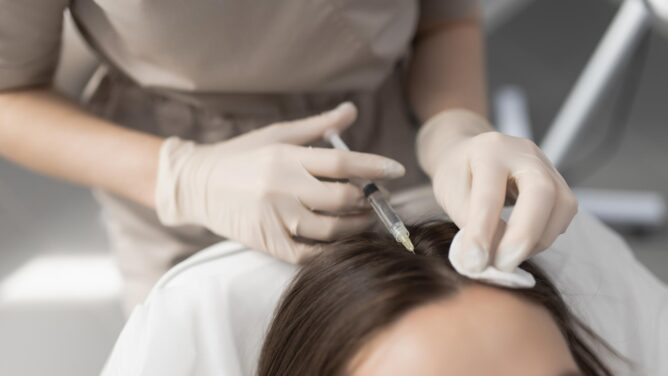
At HairON Clinic, rather than listing many treatment methods, we selectively recommend only the treatments that can realistically be expected to show results. Through this, our goal is to create practical improvement by slowing the progression of hair follicle degeneration and promoting hair growth.
Who should get a hair loss check right now?
You should consider getting a hair loss evaluation if you notice any of the following:
- The crown area of your scalp becomes increasingly visible in photos over time.
- The part line has noticeably widened compared to before.
- Your hair feels thinner or finer than it used to be.
- There is a family history of crown hair loss.
- You have recently experienced severe stress, dieting, or lack of sleep.
If even one of these applies, it is better not to delay and to get a proper examination. Crown hair loss tends to gradually worsen if left untreated. However, when detected in the early stage, it is often possible to slow its progression and improve the condition.
Many people hesitate at this stage, thinking, “It might not be serious enough to go to a clinic,” or “They might just recommend expensive treatments.”That concern is understandable, but a hair loss examination is not a commitment to treatment. It is simply a diagnostic process to understand the current condition of your hair follicles and whether treatment is needed. If there is no hair loss, you can be reassured. If there is, you can then consider your options.

At HairON Clinic, the process follows a structured medical approach: diagnosis → treatment planning > treatment > follow-up monitoring. Through accurate scalp and follicle analysis, your current condition is assessed objectively.
Book a Hair Loss Cause Diagnosis
Gangnam Station (Shinbundang Line) Exit 6 — HairON Clinic After scalp and follicle analysis, we design a customized treatment program tailored to your stage of crown hair loss. Rather than spending time worrying, accurately checking your current condition is the fastest beginning to effective treatment.
Hair Loss Research Center
View All ArticlesFind the Cause Before the Treatment.
Start with an accurate diagnosis at Hairon Clinic near Gangnam Station. Our internal medicine specialists identify the cause of your hair loss and recommend the right treatment based on the findings.
Book DiagnosisHairON ClinicHours of Operation
- Weekdays (Mon–Fri)
- Saturday
- Lunch Break
- Phone Consultation
- 3F, Hongwoo Building, 373 Gangnam-daero, Seocho-gu, Seoul, South Korea
Insights » Hair Loss Treatment by Dr. Hyunggon Son
A First Visit Story: Female Hair Loss in Her 40s at HairON Clinic
Hair loss in women in their 40s may not be simply a sign of aging. If you’re concerned about thinning hair or reduced volume, explore the causes and management options through a first visit to Hairon Clinic.