
Receding Hairline: When Should You Start Finasteride?

When you lift your bangs in the mirror, the corners of your forehead seem a little further back than before. Many men brush it off, assuming they have always had a wide forehead. We hear this often in the consultation room:
“My forehead has always been on the wide side, so I can’t tell whether I’m actually losing hair or that’s just the shape of my forehead.”
A receding hairline rarely appears all at once. The hair at both temples gradually becomes finer and the hairline slowly moves back, often forming an M-shaped hairline. Because the change is slow and quiet, it is easy to mistake for your natural forehead shape.
But while you put off a diagnosis, the changes along the hairline keep progressing. In this article, we cover the early signs of a receding hairline, why the temples thin first, why early treatment gives you more options, and what we check before prescribing hair loss medication such as finasteride.
Contents
Early signs of a receding hairline
Why the temples thin out first
Why early receding hairline treatment matters
Finasteride, dutasteride or minoxidil: what we check before prescribing
A self-check you can do now
Visiting HairON Clinic from overseas
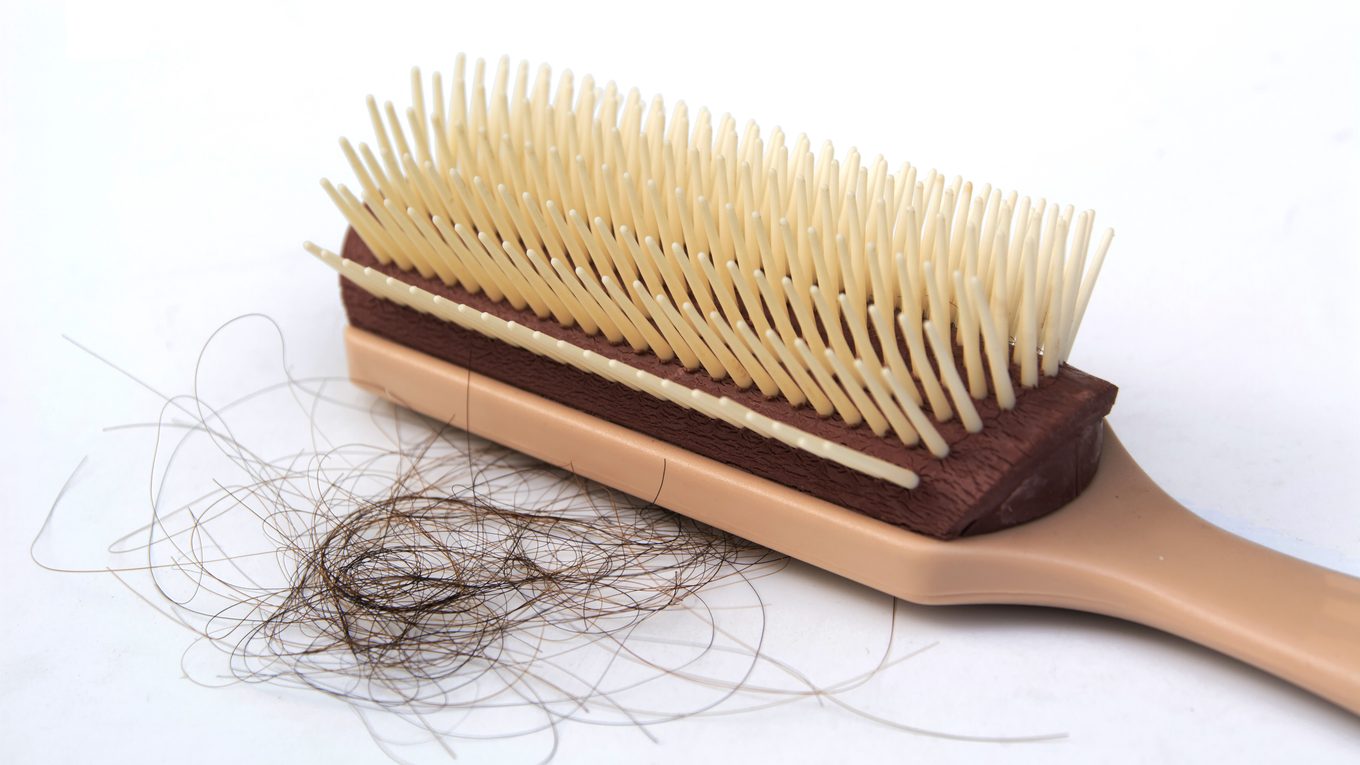
Early signs of a receding hairline
At HairON Clinic, we look at change rather than shape. Even if your forehead is naturally wide, the position of the hairline and the thickness of the hair stay the same over time. With a receding hairline, the position shifts. That is why old photos are a useful clue. Place a photo from two or three years ago next to a recent one. If the corners of your forehead have changed shape, or the hair at the edge of the hairline has become thin and limp like baby hair, it is more likely a change in progress than a matter of forehead shape. If someone in your family has had a similar change, it deserves even closer attention.
Another clue is your hairstyle. If you used to show your forehead with confidence but now feel it looks too wide unless your bangs cover it, there is a good chance your hairline has moved in the meantime.
For a step-by-step comparison, see Receding Hairline or Just a Big Forehead? How to Tell.
Why the temples thin out first
A receding hairline is a classic form of androgenetic alopecia, also known as male pattern baldness. The follicles at the temples are especially sensitive to DHT, a hormone produced from testosterone, so the hair there tends to thin and shed before other areas.
The area itself also plays a role. The hairline receives relatively less scalp blood flow, which can reduce how efficiently nutrients reach the follicles, and it is often exposed to physical stress from styling and pulling back the hair. With hormonal sensitivity, blood flow and physical stress combined, the usual order is this: hair thickness decreases and fine hairs increase in the early stage, and then the hairline recedes.

Chronic stress, lack of sleep and an irregular lifestyle can also affect how fast it progresses. Even with the same M-shaped pattern, the speed and extent vary widely from person to person depending on which factors play the biggest role.
Why early receding hairline treatment matters
At HairON Clinic, the standard we use for receding hairline treatment is not how the hairline looks right now, but how many follicles that can still respond to treatment remain. Hair loss treatment works by protecting and supporting follicle function, so the earlier the stage, when follicles remain even though the hair has thinned, the more room there is for improvement.
Here is the direction considered at each stage:
| Stage | Core treatment | Goal |
| Early | Hair loss medication as the main treatment | Slow the decline of hairline follicles |
| Progressing | Medication combined with scalp and injection treatments | Boost the response of the remaining follicles |
| Advanced | Medication to slow progression, plus a review of supplementary treatments | A plan to supplement density and the hairline |
Medication is the foundation at every stage, and more treatments are combined as the stage advances. The practical advantage of starting early is that management can begin with a simple, medication-centered plan. Because a receding hairline tends to progress faster than hair loss in other areas, the sooner you confirm your current stage, the more options you keep open.

Finasteride, dutasteride or minoxidil: what we check before prescribing
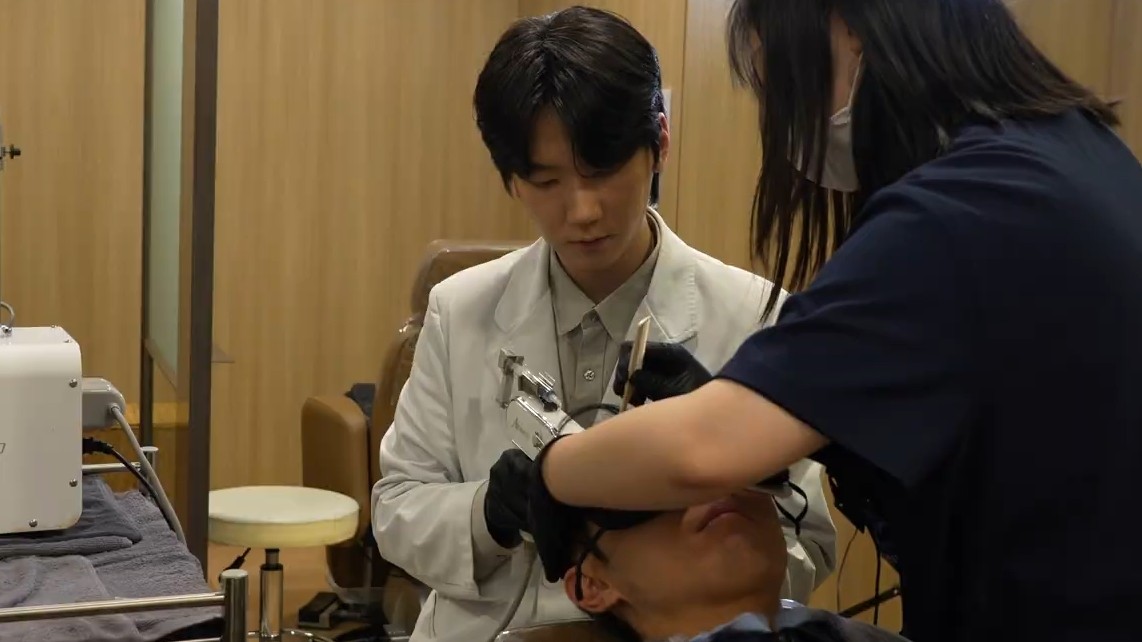
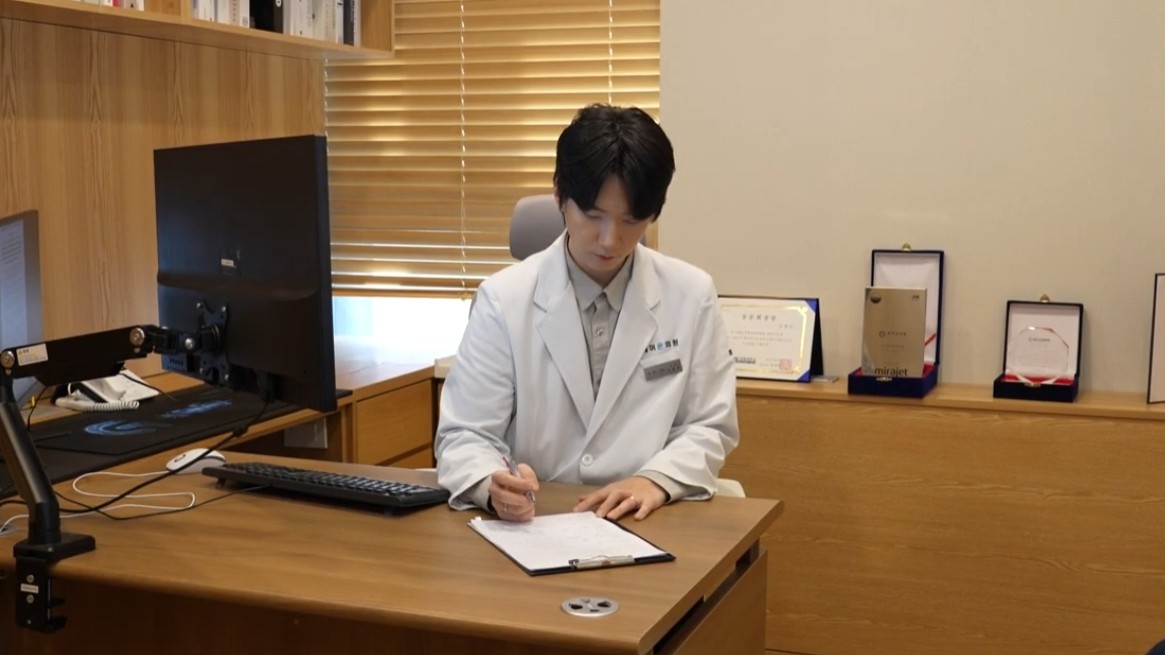
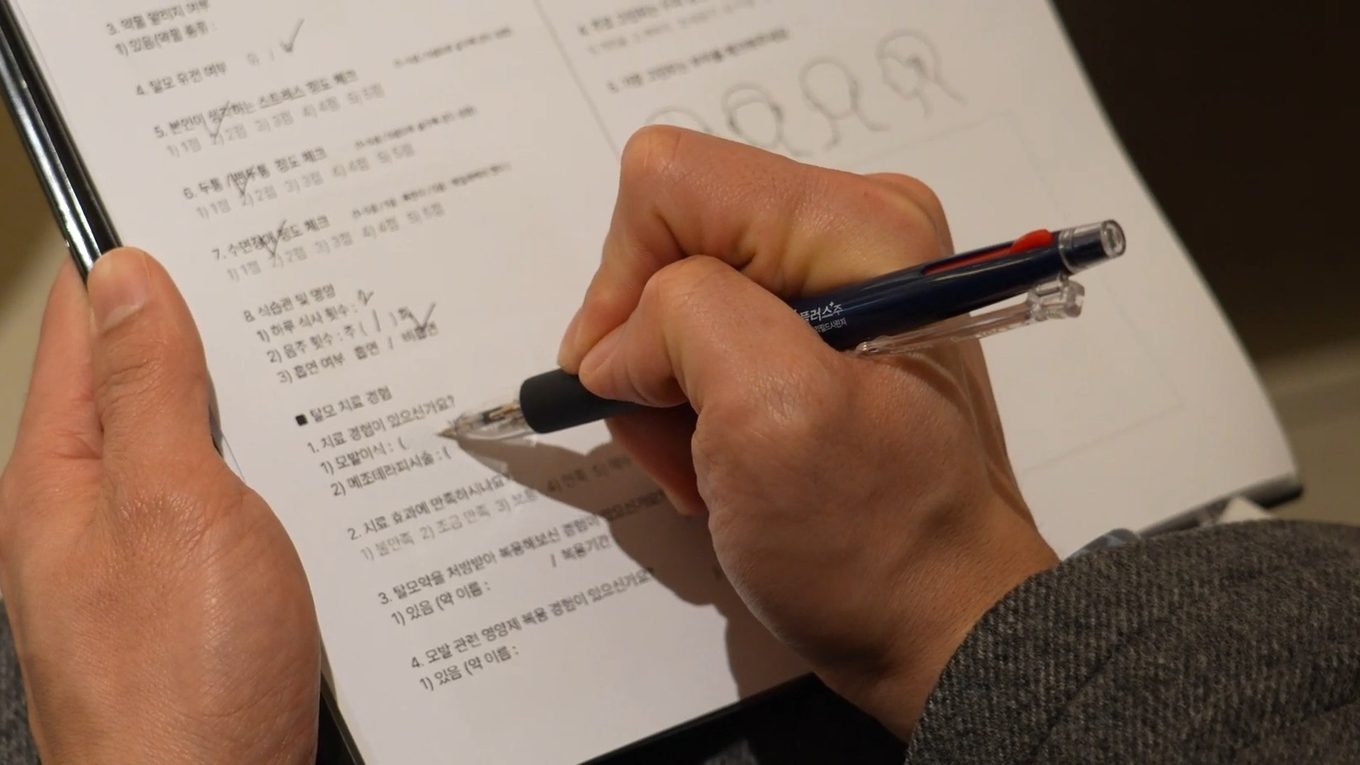
Oral hair loss medications work in different ways depending on their ingredients. Finasteride and dutasteride act on hormone-related pathways, while oral minoxidil does not regulate hormones. Before prescribing, we decide which ingredient suits you by reviewing your hair and scalp condition, the type of hair loss, contributing factors, your age and your overall health. To make this decision, an internal medicine specialist holds a consultation based on your questionnaire, and trichoscopy (a magnified scalp examination) assesses the thickness and density of the hair along the hairline, as well as whether the crown is also affected.
Once treatment begins, we review your progress regularly to see whether the current prescription is working well. If you do not see enough change with your current medication, we re-examine your condition and causes and may consider a combination prescription. At our Gangnam hair loss clinic, when hair thickness or density has decreased, we sometimes combine medication with stem cell hair loss treatment. It uses stem cells and growth factors with the aim of activating weakened follicle cells and improving overall density. For a closer look at the two hormone-pathway medications, see our article Finasteride vs. Dutasteride: Choosing the Right Medication.
A self-check you can do now
If you would like to check your condition before visiting, try the hair loss self-check on our website first.
▶ Hair Loss Self-Check: https://haironclinic.com/en/self-diagnosis/
If the self-check shows warning signs or your hairline keeps changing, a visit lets us assess your scalp and hair, diagnose the type and stage of your hair loss, and discuss treatment tailored to your individual cause.

To sum up: a receding hairline should be judged by how the hairline changes over time, not by forehead shape alone. Starting treatment early, while responsive follicles remain, allows a simpler, medication-centered plan. And before any prescription, a thorough consultation determines which medication suits your condition. Treatment response and the time it takes to see results vary with each person’s scalp condition and stage of hair loss, so the best first step is to confirm where you are now at a hair loss clinic in Gangnam.
Visiting HairON Clinic from overseas
If you are visiting Seoul and would like to have your hair loss checked, here is what to know before you come.
Location: 3F, Hongwoo Building, 373 Gangnam-daero, Seocho-gu, Seoul. A 2-minute walk (about 60 m) from Gangnam Station Exit 6 (Shinbundang Line).
Hours: Monday–Friday 10:00 AM–8:00 PM; Saturday 10:00 AM–3:00 PM. Lunch break 2:00–3:00 PM.
Your first visit: the consultation and diagnostic tests take about 60 minutes on average.
What to bring: photos of your hairline from a few years ago, a list of any hair loss medications you have tried, and any previous test results.
Questions before you visit: message us on WhatsApp (https://api.whatsapp.com/send?phone=821095443536) or call +82-2-6949-2030.
We offer consultations in English. If you are in Seoul for a limited time, let us know your travel dates when you contact us, and we will plan your visit around your schedule.
Related reading
Noticing an M-Shaped Hairline? Is Medication Sufficient? Why Early Treatment Matters
Finasteride vs. Dutasteride: Choosing the Right Medication
Checklist: What to Know Before Starting Hair Loss Medication
Book a Hair Loss Cause Diagnosis
Gangnam Station (Shinbundang Line) Exit 6 — HairON Clinic After scalp and follicle analysis, we design a customized treatment program tailored to your stage of crown hair loss. Rather than spending time worrying, accurately checking your current condition is the fastest beginning to effective treatment.
Hair Loss Research Center
View All ArticlesFind the Cause Before the Treatment.
Start with an accurate diagnosis at Hairon Clinic near Gangnam Station. Our internal medicine specialists identify the cause of your hair loss and recommend the right treatment based on the findings.
Book DiagnosisHairON ClinicHours of Operation
- Weekdays (Mon–Fri)
- Saturday
- Lunch Break
- Phone Consultation
- 3F, Hongwoo Building, 373 Gangnam-daero, Seocho-gu, Seoul, South Korea
Insights » Hair Loss Treatment by Dr. Hyunggon Son
A First Visit Story: Female Hair Loss in Her 40s at HairON Clinic
Hair loss in women in their 40s may not be simply a sign of aging. If you’re concerned about thinning hair or reduced volume, explore the causes and management options through a first visit to Hairon Clinic.